
Home › Health & Wellness › Supplements
WHAT WE ACTUALLY TAKE
He Counted Nine Supplements in the Drawer and Could Account for Six. The Problem Was Never Which Ones He Had Bought.

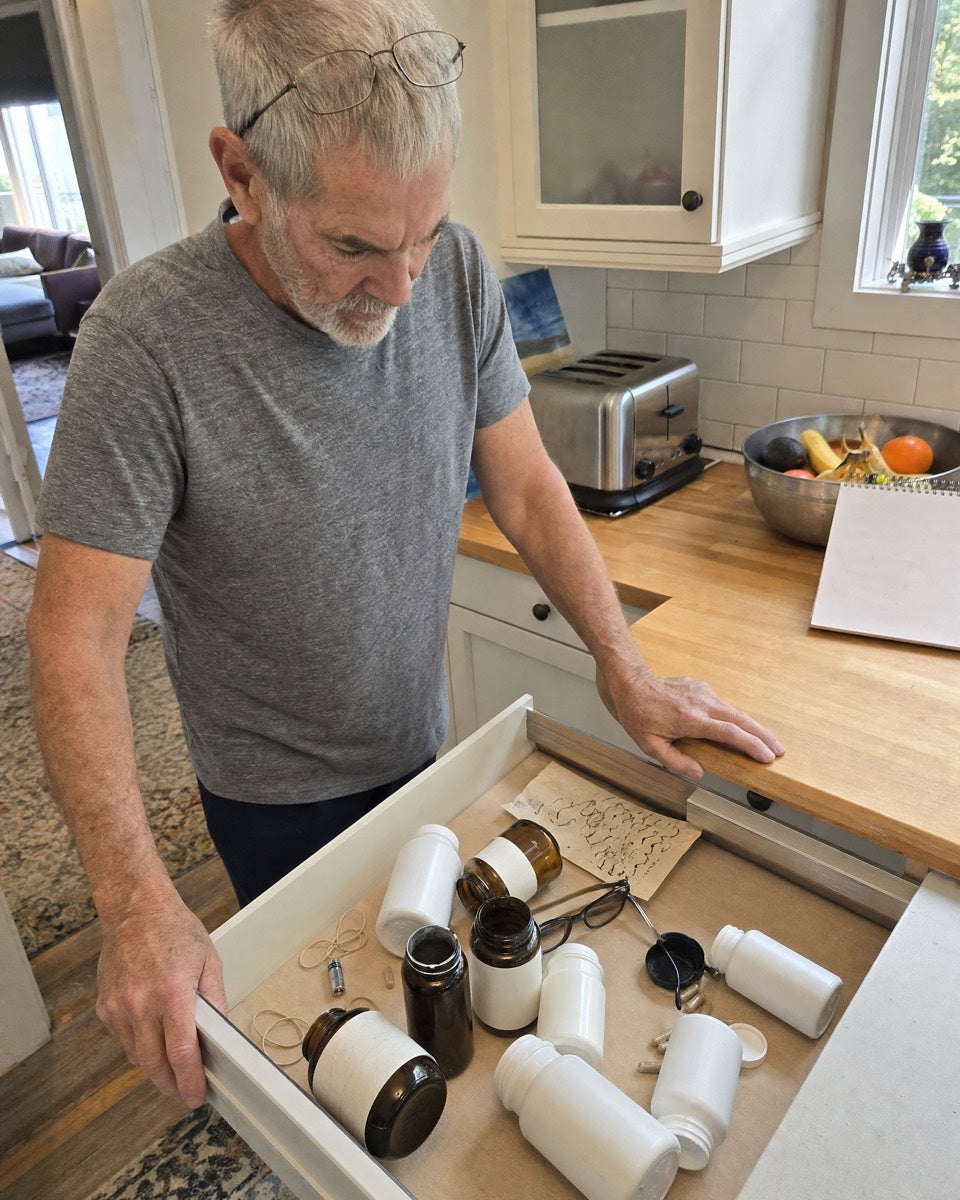
A record of good intentions, each abandoned somewhere around the third week.
The drawer in Tom's kitchen had nine things in it, and he could only account for six.
He counted them on a Sunday in February, because his wife had asked a reasonable question about why there were two of something. There was beetroot powder, bought after a podcast. A CoQ10 he could not remember buying at all. A B complex, a magnesium, a fish oil, an aged garlic, and three containers whose labels had worn off in the drawer.
He was taking perhaps two of them with any regularity. The rest were a record of good intentions, each one bought on a day he had decided to take his heart seriously, and each one abandoned somewhere around the third week.
Nobody plans a supplement drawer
It accumulates. You buy one thing because of something you read, a second because the label on the first mentioned it, a third because somebody at work swore by it, and a fourth because it was next to the third on the shelf.
A year later it is not a routine, it is an archaeology. Four lids, four schedules, four reorder dates that never line up, and a quiet background hum of guilt every time the drawer opens.
Nine containers. Six he could account for.
"4 different pills each day and no effect, I felt like a walking pharmacy."
The part that is never the ingredients
Here is what Tom had got wrong, and it is what almost everybody gets wrong. He thought the problem was that none of them had worked.
The actual problem was that a routine with four moving parts fails at its weakest one, and then takes the other three down with it. Miss the morning for a week because you were travelling, and you do not resume three of the four. You resume none of them. Four bottles do not become four habits. They become four chances to stop.
Read the forums where people discuss this and the same confession surfaces constantly. "I'm being honest with myself in that I'm not going to get a powder I have to drink because I simply will not be able to maintain that." That is not a man being lazy. That is a man who has met himself before.

Every house has one of these shelves, and almost everything on it was bought in January.
What the drawer was actually costing him
The money was not really the point, although it was not nothing either. Nine containers is a standing order for something you are not doing.
What it cost him turned up at his own check up, in the form of a sentence he had to say out loud. Yes, he had been meaning to. He had an entire drawer to prove the meaning to. He had nothing whatsoever to prove the doing.
That is the particular sting of a supplement drawer. It is not evidence of neglect. It is evidence of care that never quite converted, sitting in the kitchen, reminding you every time you go looking for a teaspoon.
And the reason it stings is that the intention was never the problem. Tom had the intention four separate times. What he did not have was a version of it that survived a fortnight away from home.
What the four were actually for
The strange thing about Tom's drawer is that the four he was aiming at genuinely belong together. He had just bought them as four separate decisions, months apart, without anyone ever laying out why they sit in the same conversation.
Beetroot is a natural source of dietary nitrate. Your body turns nitrate into nitric oxide, and nitric oxide is the signal that tells the muscle in a blood vessel wall to relax, so blood reaches the tissue asking for it with less work.
Grape seed extract is the most studied of the four. Pooling sixteen randomised trials across 810 people, researchers found it lowered systolic pressure by around six points and diastolic by nearly three, at doses running from 100 mg to 800 mg.
CoQ10 is the one aimed at how tired you feel rather than at a number. Thirteen trials covering 1,126 people found it reduced fatigue scores against placebo, in healthy people as well as unwell ones.
B vitamins support normal energy metabolism, which is the least dramatic sentence on this page and also the reason the B complex was in the drawer.
Why the labels made it worse
There is a second thing wrong with the drawer, and the forums are blunter about it than any brand would be.
"I think one issue is that the doses aren't correct. Most supplements under dose and pills are dosed at 1g or below." And the question underneath all of it: "How do you compare a beet root supplement when the label doesnt print nitrate?"
Once you have bought four things and cannot verify the amount in any of them, you are not running a routine. You are running a hope. A proprietary blend is a label that has decided you do not need to know.
What actually changes, and when
Nothing happens on Tuesday, and anyone who tells you otherwise is selling something else. Beetroot works over weeks rather than days because it is doing slow structural work and not stimulant work. So the first fortnight is quiet, and that is exactly what it should be.
Around the third week is where most people notice something, and it tends to arrive as an absence rather than as a feeling. The afternoon slump does not turn up on schedule, so you reach four o'clock with something still in the tank. You have not poured the second coffee that would have cost you the evening. Walks get longer before your legs start negotiating, and stairs stop announcing themselves. That is nitric oxide doing its one job. It tells the muscle in a vessel wall to relax, so blood reaches the tissue asking for it.
By week six or eight the quieter work is underway in places you cannot feel, which is why grape seed sits in there alongside the beetroot. Across sixteen randomised trials and 810 people it lowered systolic pressure by around six points. The CoQ10 has thirteen trials behind it, covering 1,126 people who reported less fatigue than placebo. Those are modest numbers rather than dramatic ones, but they are measured. They are also the reason you would keep taking something you can no longer feel.
And here is the part Tom did not expect, because it has nothing to do with ingredients. Three weeks in, the pouch is still there. The routine has not quietly collapsed the way every four bottle version of it did, and he has not had to start again in January with a fresh set of good intentions. Consistency is what makes everything above possible, because the supplement you take beats the better one you keep meaning to.
Over months it stops being a project and becomes a shelf item, like the kettle. Circulation is not something you fix once and tick off, it is something you keep, and keeping it is dull work that only gets done when it is easy.
What Tom keeps in the drawer now
One pouch, and he has thrown out six things.
It is made by Nouvalor and it is called BEETS. Each two chew serving carries 500 mg of beetroot, 150 mg of grape seed extract, 100 mg of CoQ10 and the B vitamins, with every amount printed on the pouch rather than hidden inside a blend. There is no caffeine in it and no stimulant of any kind.
The claim being made here is narrower than most. It is not that these four work better together than apart, because that is not what the research says and nobody has tested the combination. It is that four containers is four reorder dates, four schedules and four chances to quit, and that one pouch is one habit. For the routines that die in February, which is most of them, that turns out to be the part that was failing.
It also carries a money back guarantee that runs up to 60 days, which is roughly how long beetroot needs before it has anything to say.
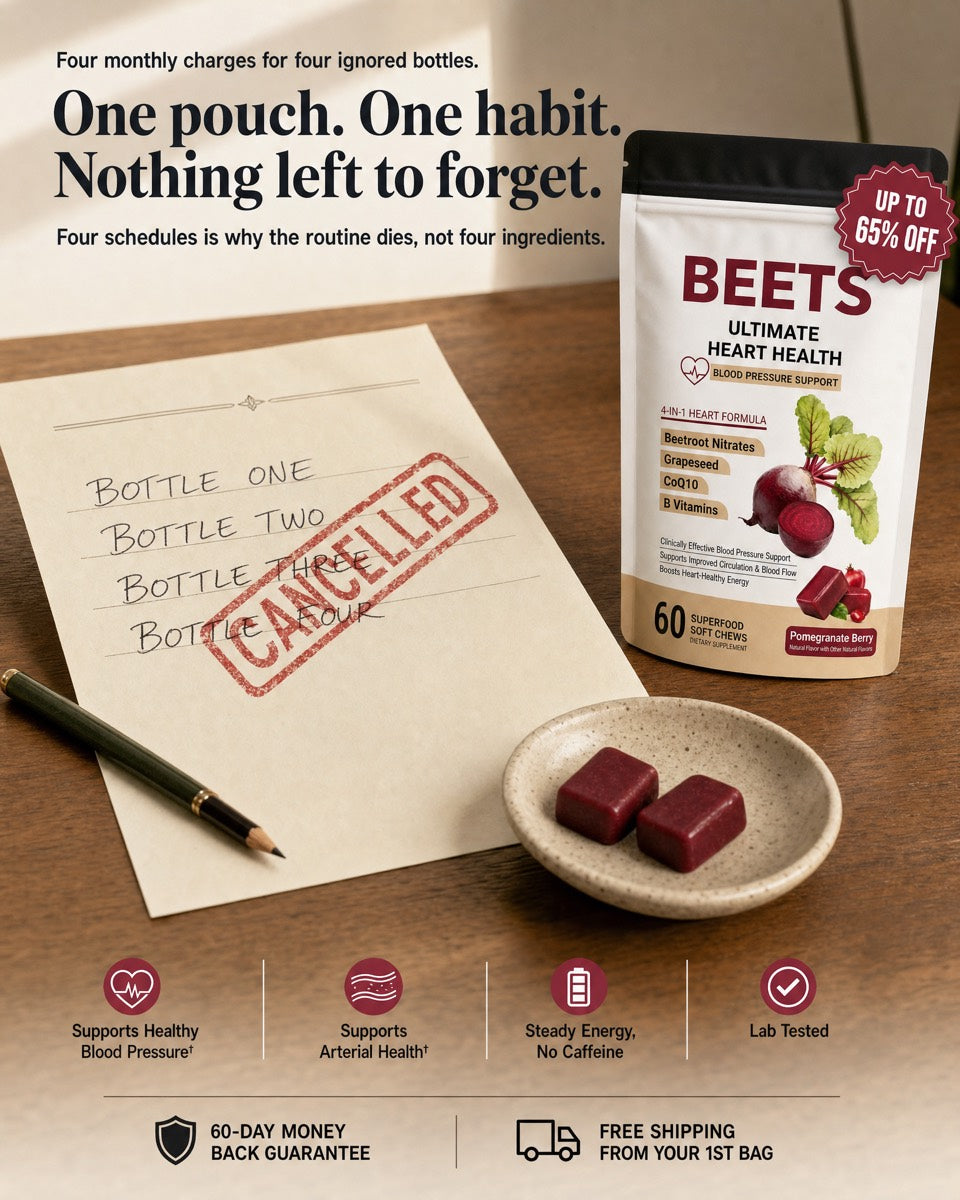
Four schedules is why the routine dies, not four ingredients.
What people who take them actually say
I will not email a brand to ask what is in the blend. The panel here already answers. Separate amounts for the main ingredients are the reason this pouch made it home.
Serving size stayed obvious on a trip: two, not a reconstruction of scoops. I did not bring a second product to complete the formula. Clear size is the entire travel friendly argument besides the pouch itself.
The beet powder tub used to live behind the mugs and I ignored it. Chews fit on that same shelf and I actually use them with the first cup. Mixing was the reason the powder failed, not the ingredient list.
Packaging looked tidy and the ingredient panel was readable in the store lighting. Then the berry chew was less earthy than I feared. First impressions actually matched the second week.
These statements have not been evaluated by the Food and Drug Administration. This product is not intended to diagnose, treat, cure or prevent any disease. Individual results may vary.
